Home / Self-determination
Self-determination
What Kashmiris actually want
This is the question the whole dispute is supposedly about, and it is the one almost nobody asks. It has been asked properly, once, by a survey of 3,774 people. The answer is not what either government says it is.
The survey
Kashmir: Paths to Peace, by Robert W. Bradnock of King’s College London, was published by Chatham House — the Royal Institute of International Affairs — in May 2010.[1] Chatham House states of itself that it “does not express opinion of its own.”
| Interviews | 3,774 face-to-face, adults aged over 16 |
|---|---|
| Fieldwork | 17 September – 28 October 2009, after an August 2009 pilot |
| Indian-administered J&K | 2,374 respondents, in 11 of the 14 pre-2008 districts |
| Pakistan-administered AJK | 1,400 respondents, in 7 of the 8 districts |
| Method | Quota sampling, random selection of individuals, data weighted |
| Conducted by | FACTS Worldwide (India) and Aftab Associates (Pakistan) |
It is the only survey of its kind ever conducted on both sides of the Line of Control. It is fifteen years old, and no government has permitted a comparable one since. That absence is not an accident.
The question
Respondents were asked: “If you were given the choice in a vote tomorrow, which one of these, if any, would you vote for?” — independence for the whole of Kashmir; join India; join Pakistan; the Line of Control made a permanent border; two forms of joint sovereignty; or no change.[1]
The answer, in the Kashmir Valley
And the figure that dismantles both governments’ accounts of this dispute at once:
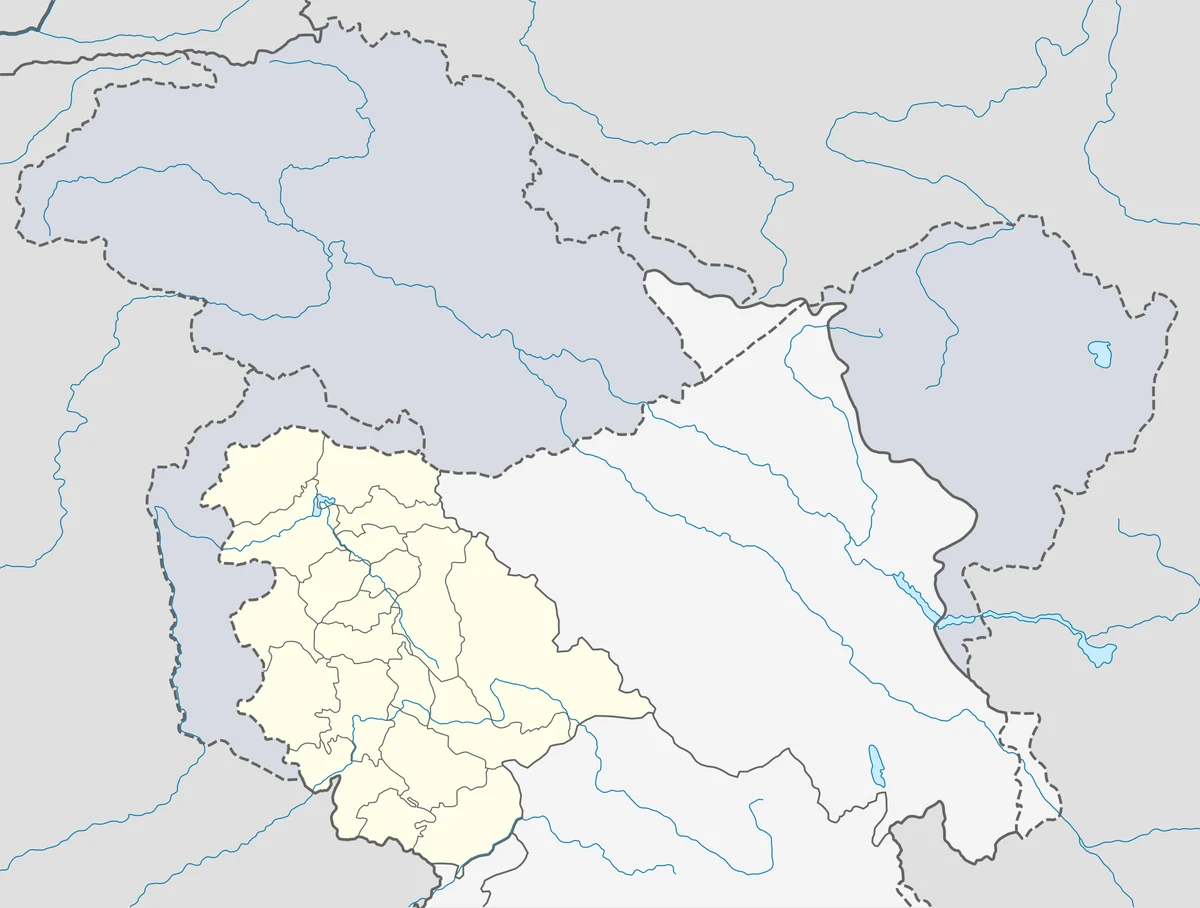
Read those two together. In the Kashmir Valley — the heart of the territory, and the place where almost every event in this dossier happened — the people do not want to be Indian and they do not want to be Pakistani. Between three-quarters and ninety-five per cent of them want to be neither.
This site is argued from a Pakistani perspective and it prints that finding in full, at the top of the page, in the largest type on it. Anyone who tells you Kashmiris are waiting to join Pakistan is not describing the only serious survey ever taken. What Kashmiris have asked for, overwhelmingly and consistently, is to be let alone to decide.

The whole territory, honestly
The site’s standards require the inconvenient half of this finding as well, so here is the complete table.
| Option | Total | AJK | J&K | Srinagar | Baramula | Badgam | Anantnag | Jammu | Leh | Kargil |
|---|---|---|---|---|---|---|---|---|---|---|
| Independence | 43 | 44 | 43 | 82 | 95 | 75 | 74 | 1 | 30 | 20 |
| Join India | 21 | 1 | 28 | 8 | 2 | 10 | 22 | 47 | 67 | 80 |
| Join Pakistan | 15 | 50 | 2 | 6 | 2 | 7 | 2 | * | 0 | 0 |
| LoC made permanent | 14 | 1 | 19 | 0 | 0 | 1 | 0 | 39 | 2 | 0 |
| Joint sovereignty | 1–2 | 2 | 1–2 | 1 | * | 0 | 0 | 5 | 1 | 0 |
Three things follow, and the site says all three:
- Independence is the single most popular option anywhere in the territory — 43% overall, 44% in Pakistan-administered Azad Kashmir, 43% in Indian-administered J&K.
- It is not a territory-wide majority. Bradnock records a majority for outright independence in only four districts, all in the Kashmir Valley Division, and support of 1% or less in five others. Jammu Division is close to zero.[1]
- The territory is genuinely divided, and that is the argument for a vote, not against one. A population this polarised by region is precisely the kind that cannot be spoken for by either capital — and precisely the kind whose future the Security Council said in 1948 should be settled by asking it. The legal case →
Why this page does not say the territory “belongs to” anyone
Because the people who live there do not say that, and because this site does not print claims it cannot source.
What is documented is narrower and much harder to answer: the territory’s status is unresolved in international law; India took the dispute to the Security Council itself in January 1948; the Council’s answer was a free and impartial plebiscite; both states accepted that principle; the plebiscite has never been held; and when the inhabitants were finally asked something like the question, in the only serious survey ever taken, the Kashmir Valley answered by three-quarters to ninety-five per cent that it wanted neither state.
An argument that rests on the will of the people is stronger than one that rests on a title deed — and it is the only argument that treats Kashmiris as the subject of their own history rather than as territory being contested over their heads.
What they said was wrong with their lives
The same survey asked what the main problems facing Kashmir were. The answer is not the one either government campaigns on.
Ninety-six per cent of people in Srinagar said the main problem facing them was that there was no work. What the conflict costs Kashmiris →
Sources & notes
- Robert W. Bradnock, Kashmir: Paths to Peace, Chatham House (Royal Institute of International Affairs), May 2010. A project directed by Robert Bradnock and Richard Schofield, King’s College London. 3,774 face-to-face interviews with adults over 16, conducted 17 September – 28 October 2009: 2,374 in 11 of the 14 pre-2008 districts of Jammu and Kashmir (Doda, Pulwama and Kupwara excluded) and 1,400 in 7 of the 8 districts of Azad Jammu and Kashmir. Vote figures are Table 6; problem rankings are Figures 3–4 and the accompanying tables. A copy is held locally by this project with its SHA-256 recorded. Report PDF. Limitations, as the report states them: quota rather than probability sampling; a 70/30 male/female quota in AJK because of the difficulty of interviewing women there; a predominantly urban sample with a 40% rural quota; and three J&K districts not covered. It is fifteen years old. It remains the only survey of its kind conducted on both sides of the Line of Control.