Home / The law
The law
The legal case, in the order it has to be made
Four questions decide the legal argument over Kashmir: what the accession was, what the Security Council required, what Article 370 protected, and what was done to it on 5 August 2019.
1. The accession, and the condition attached to it
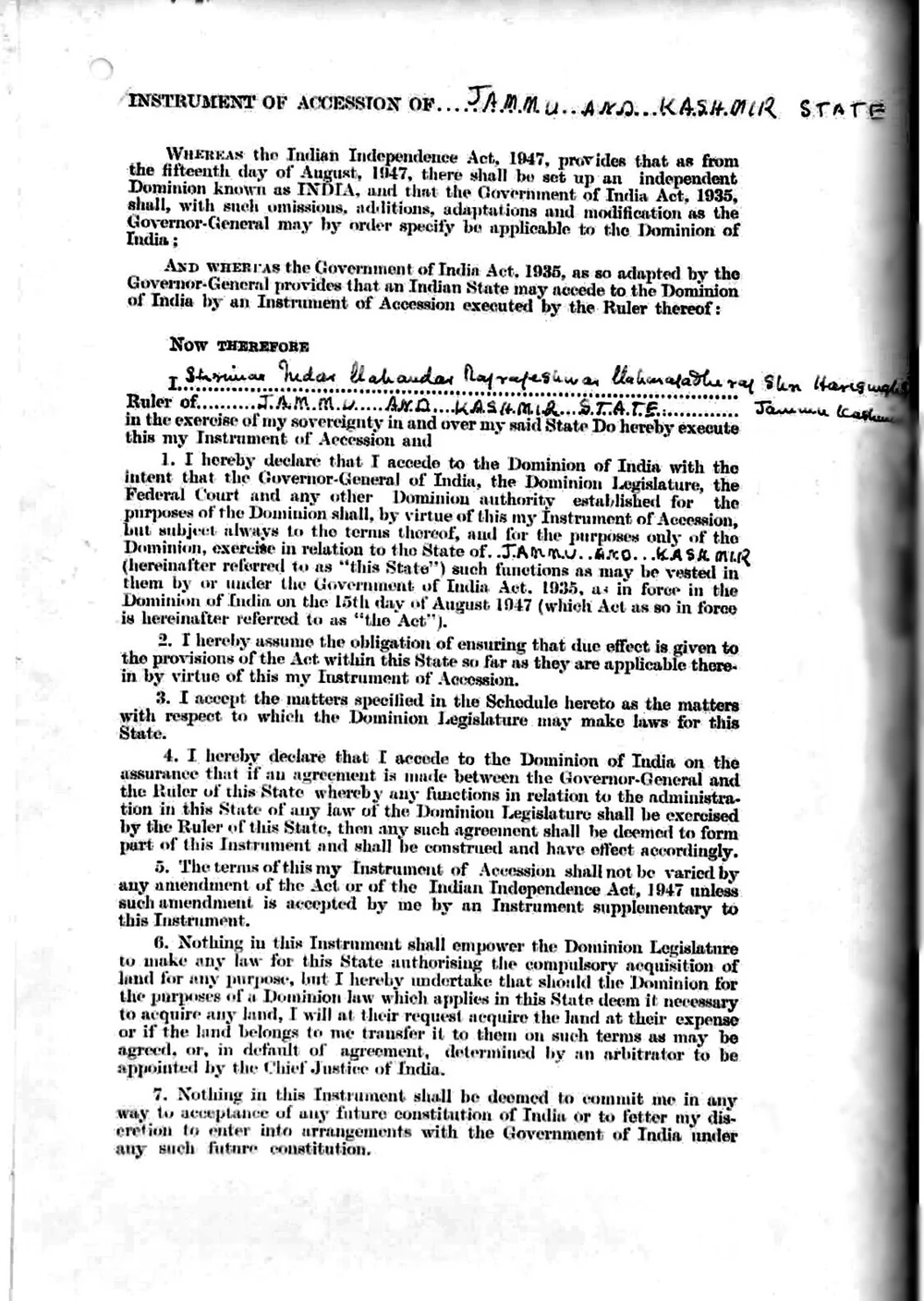
On 26 October 1947, with tribal fighters advancing on Srinagar, Maharaja Hari Singh signed the Instrument of Accession to India. Two features of that moment carry the whole subsequent argument.
The first is who signed. The signatory was an unelected hereditary ruler whose family had acquired the territory by purchase in 1846, governing a population that had no say in either transaction. Whatever the Instrument did as a matter of the law of princely states, it was not an act of popular consent.
The second is that India’s acceptance was not unconditional in political terms. India accepted the accession alongside the undertaking that the question would ultimately be referred to the people of the state once order was restored. It was India that then took the dispute to the United Nations Security Council, on 1 January 1948, under Article 35 of the Charter.
This matters because it disposes of the claim that the international dimension of Kashmir is a Pakistani invention. The file was opened at India’s own request.

2. What the Security Council required
Security Council Resolution 47, adopted 21 April 1948, set out a three-part settlement:[1]
- Pakistan to secure the withdrawal of the tribesmen and Pakistani nationals who had entered the state for the purpose of fighting;
- India to progressively reduce its forces to the minimum required for the maintenance of law and order;
- a free and impartial plebiscite, administered by a Plebiscite Administrator nominated by the United Nations, to determine the will of the people on the question of accession.
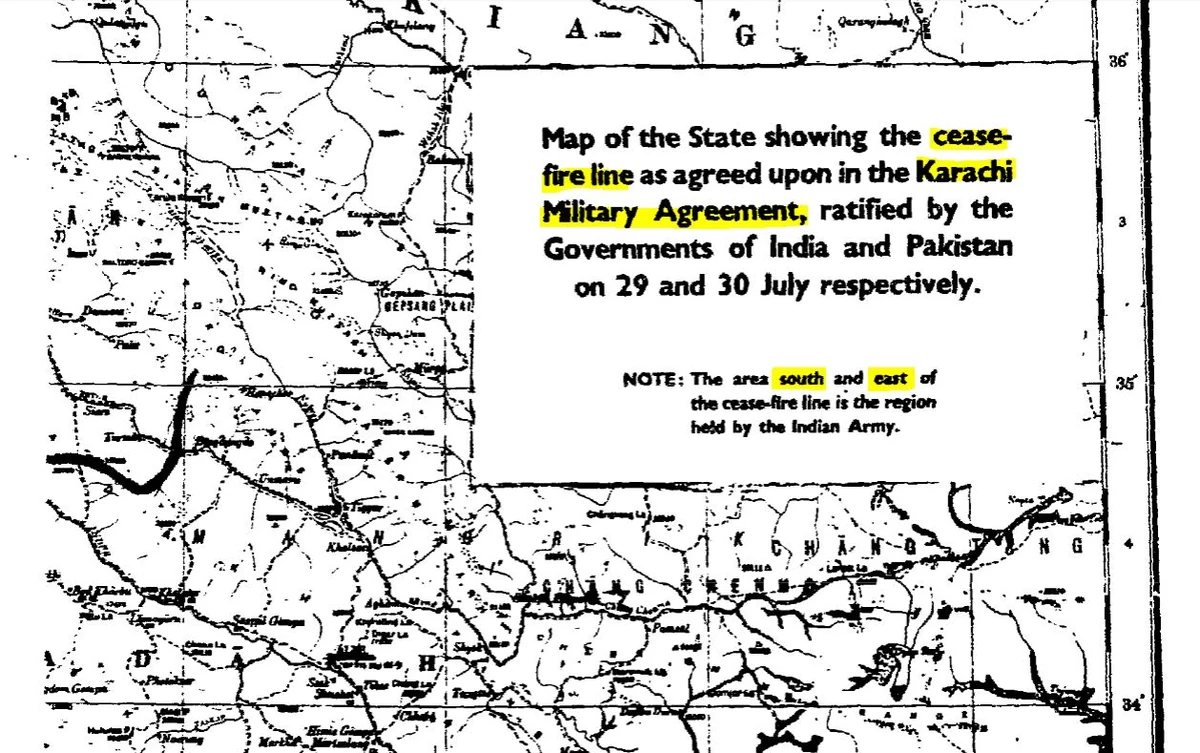
The United Nations Commission for India and Pakistan then adopted two further resolutions, on 13 August 1948 and 5 January 1949, amplifying that framework. Both India and Pakistan accepted them. A ceasefire took effect on 1 January 1949 and the ceasefire line was fixed by the Karachi Agreement of 27 July 1949.
The plebiscite has never been held. Seventy-eight years later, no inhabitant of the territory has ever been asked, in any internationally supervised process, what they want.
The honest state of this argument
India’s position is that the resolutions were conditional and sequential: the plebiscite was contingent on a Pakistani withdrawal that never happened, so the obligation never matured. India further argues that the Simla Agreement of 1972 made the dispute bilateral and displaced the UN framework, and that the state’s Constituent Assembly ratified accession in the 1950s.
These are real arguments and this site does not pretend otherwise. But note what they concede and what they do not answer. They concede that a plebiscite was the agreed measure of legitimacy. They do not explain why, on any reading, the people of the territory should never be asked at all — nor how a Constituent Assembly elected in the conditions of the 1950s, with the region’s most popular leader dismissed and imprisoned in 1953, substitutes for the free and impartial vote both states accepted in principle.
Simla is also a weaker answer than it appears: it commits the parties to a bilateral settlement, not to no settlement. Fifty-four years of bilateralism have produced no settlement at all.

3. What Article 370 and Article 35A actually did
Article 370, inserted 17 October 1949, gave Jammu and Kashmir a distinct constitutional position within India: its own constitution, and a limit on the Union Parliament’s power to legislate for the state without its concurrence. Article 35A, added by Presidential Order on 14 May 1954, let the state legislature define ‘permanent residents’ and reserve to them rights in land, public employment and settlement.
Read together, they were the constitutional terms on which a Muslim-majority territory sat inside a much larger state: the guarantee that its land could not be bought out from under it and its demographic composition could not be engineered from outside. Whether or not one thinks that arrangement wise, that is what it was — and it was the arrangement on which the accession had been sold to Kashmiris for seventy years.
4. What was done on 5 August 2019
The mechanism matters, because the mechanism is the objection.
Article 370(3) allowed the President to declare that the Article should cease to operate, but on the recommendation of the Constituent Assembly of the State. That Assembly had ceased to exist in 1957. On its face, the power had no functioning trigger.
| Step | What was done | Effect |
|---|---|---|
| C.O. 272 | A Presidential Order amended how Article 367 — the interpretation clause — was to be read, so that the reference to the ‘Constituent Assembly of the State’ in Article 370(3) would be read as the Legislative Assembly of the State. | Supplied a body capable of giving the recommendation that Article 370(3) required. |
| Governor’s concurrence | Jammu and Kashmir was under direct central rule. There was no sitting Legislative Assembly. Its functions were exercised by Parliament, and the concurrence of the ‘State Government’ was given by the Governor — an appointee of the Union. | The Union, in substance, furnished the state’s consent to the removal of the state’s own protections. |
| C.O. 273 | A further Order declared that Article 370 ceased to be operative. | Article 370, and with it Article 35A, gone. |
| Reorganisation Act | Parliament split the state into two Union Territories: Jammu & Kashmir, and Ladakh. | A state of the Union downgraded to centrally administered territory — and, uniquely, without the consent of its legislature, because it had none. |
Set out plainly: a constitutional protection that required the consent of the state was removed by a Union-appointed Governor standing in for a legislature that did not exist, using an amendment to the interpretation clause to redefine the body whose consent was needed. It was done while the region’s elected politicians were in detention and every telephone and internet connection in the territory had been cut.
That last point is not colour. The people whose constitutional status was being altered were physically unable to learn of it, speak about it, organise against it, or go to court about it. The blackout →
5. The Supreme Court, 11 December 2023
A five-judge Constitution Bench of the Supreme Court of India ruled on twenty-three petitions challenging the abrogation. It unanimously upheld the President’s power, holding C.O. 272 and C.O. 273 lawful and characterising Article 370 as a ‘temporary provision’ addressing specific historical circumstances, which did not become permanent when the state’s Constituent Assembly dissolved.[2]
This site reports that outcome rather than wishing it away. Three observations, all of them drawn from the judgment itself rather than from commentary:
- The Court also directed relief. It directed that statehood be restored and that elections be held. A judgment that finds nothing wrong does not usually need to order repairs.
- It is a domestic ruling on a domestic question. The Court determined whether the manoeuvre was valid under the Constitution of India. It did not, and could not, determine the status of the territory under the Security Council resolutions. A state’s own supreme court is not the forum that settles whether that state’s title to a disputed territory is good.
- ‘Temporary’ cuts both ways. If Article 370 was a temporary accommodation pending a final settlement of the territory’s status, then removing it unilaterally, without that settlement and without the population’s consent, does not complete the accession. It removes the last of the terms on which the accession was justified.
The full counter-argument on the judgment is here.
6. What the law requires now, regardless of status
The sovereignty question can be argued forever. The human rights question cannot, because it does not depend on the answer. Whoever is entitled to administer Jammu and Kashmir, the administering power is bound by obligations it has itself accepted:
- ICCPR — India acceded in 1979. Article 6 (life), Article 7 (torture), Article 9 (arbitrary detention), Article 19 (expression). Prolonged administrative detention without charge and communications shutdowns of the scale imposed engage all four.
- Convention against Torture — India signed in 1997 and has still not ratified. It remains one of a small number of states in that position, and the 432-case torture record documented in 2019 is the context in which that omission should be read.
- The prohibition on collective punishment — punitive demolition of family homes was identified by fourteen UN mandate holders in November 2025 as collective punishment, in defiance of India’s own Supreme Court.[3]
- The duty to investigate — an obligation that does not evaporate because a domestic statute withholds sanction to prosecute. Section 7 of AFSPA is not a defence in international law; it is the evidence of the violation. Impunity →
This is why the site leads with the record and not with the flag. You do not have to accept a single word about sovereignty to accept that 2,730 unmarked graves, and 574 bodies identified as local out of 2,156 examined, require an investigation, and that in more than three decades there has not been one prosecution.
Sources & notes
- UN Security Council Resolution 47 (1948), 21 April 1948. Text. Followed by the UNCIP resolutions of 13 August 1948 and 5 January 1949, accepted by both India and Pakistan.
- In Re: Article 370 of the Constitution, Supreme Court of India, judgment of 11 December 2023, neutral citation 2023 INSC 1058. A five-judge Constitution Bench: Chief Justice Dr Dhananjaya Y Chandrachud, Justice Sanjay Kishan Kaul, Justice Sanjiv Khanna, Justice Bhushan R Gavai and Justice Surya Kant — all five named in the judgment. 476 pages. The neutral citation appears on the judgment’s own first page. A copy is held locally by this project and its SHA-256 hash recorded, because the record has a habit of disappearing. Full judgment (PDF) · Indian Kanoon · Supreme Court Observer summary. Read the judgment rather than anyone’s characterisation of it, including this site’s.
- UN OHCHR Special Procedures, 24 November 2025.