The two counts
2018 is the cleanest year to examine, because the United Nations printed both counts in the same paragraph of the same report.[1]
| Counted by | Civilians | Militants | Security forces | Total |
|---|---|---|---|---|
| JKCCS | ~160 | 267 | 159 | 586 |
| Ministry of Home Affairs | 37 | 238 | 86 |
On militants and security forces the two counts are close. On civilians they differ by more than fourfold. That is not a methodological quibble at the margins — it is a disagreement about whether roughly a hundred and twenty people were civilians at all.
OHCHR recorded 586 as the highest number of conflict-related casualties since 2008, and the ~160 civilian deaths as believed to be the highest in over a decade.
Who killed the civilians
JKCCS’s breakdown of the 160, as reported by OHCHR:[2]
| Attributed to | Deaths |
|---|---|
| Indian security forces | 71 |
| Armed group members or unidentified gunmen | 43 |
| Shelling and firing by Pakistani troops along the Line of Control | 29 |
The third row belongs on this site as much as the first. Twenty-nine civilians killed by Pakistani shelling is in the same UN paragraph as the seventy-one killed by Indian forces, and a site that printed one and hid the other would deserve to be disbelieved about both.
The decade figure
What happens after a civilian is killed
This is the part that turns a death toll into a pattern. OHCHR recorded in July 2019 that:[3]
- despite the high number of civilians killed near encounter sites in 2018, there was no information about any new investigation into excessive use of force leading to casualties;
- there was no information on the status of the five investigations launched into extrajudicial executions in 2016;
- Jammu and Kashmir established no investigations at all into civilian killings in 2017;
- no prosecutions were reported;
- it did not appear that Indian security forces had been asked to re-evaluate or change their crowd-control techniques or rules of engagement.
A hundred and sixty people die, seventy-one of them at the hands of the state, and the documented institutional response is nothing. Why that is structural rather than accidental →

The massacres
Six incidents, spread across a decade, in which security forces killed unarmed civilians in numbers. Not one has produced a conviction.
| Incident | Force | Recorded dead | Outcome |
|---|---|---|---|
| Gawkadal bridge, Srinagar | CRPF | No prosecution. Commonly described as the largest single killing of protesters in the conflict. | |
| Zakoora & Tengpora, Srinagar | Security forces | No prosecution. | |
| Funeral procession, Srinagar | CRPF | at least 47 | Documented by Amnesty International. Fired on mourners at the funeral of Maulvi Mohammed Farooq. No prosecution. |
| Sopore | BSF | 13 | Documented by Amnesty International. Entered houses and shot inhabitants. No prosecution. |
| Sopore | BSF | at least 53 | Amnesty published a dedicated case study. Houses burned, shops looted. No conviction. |
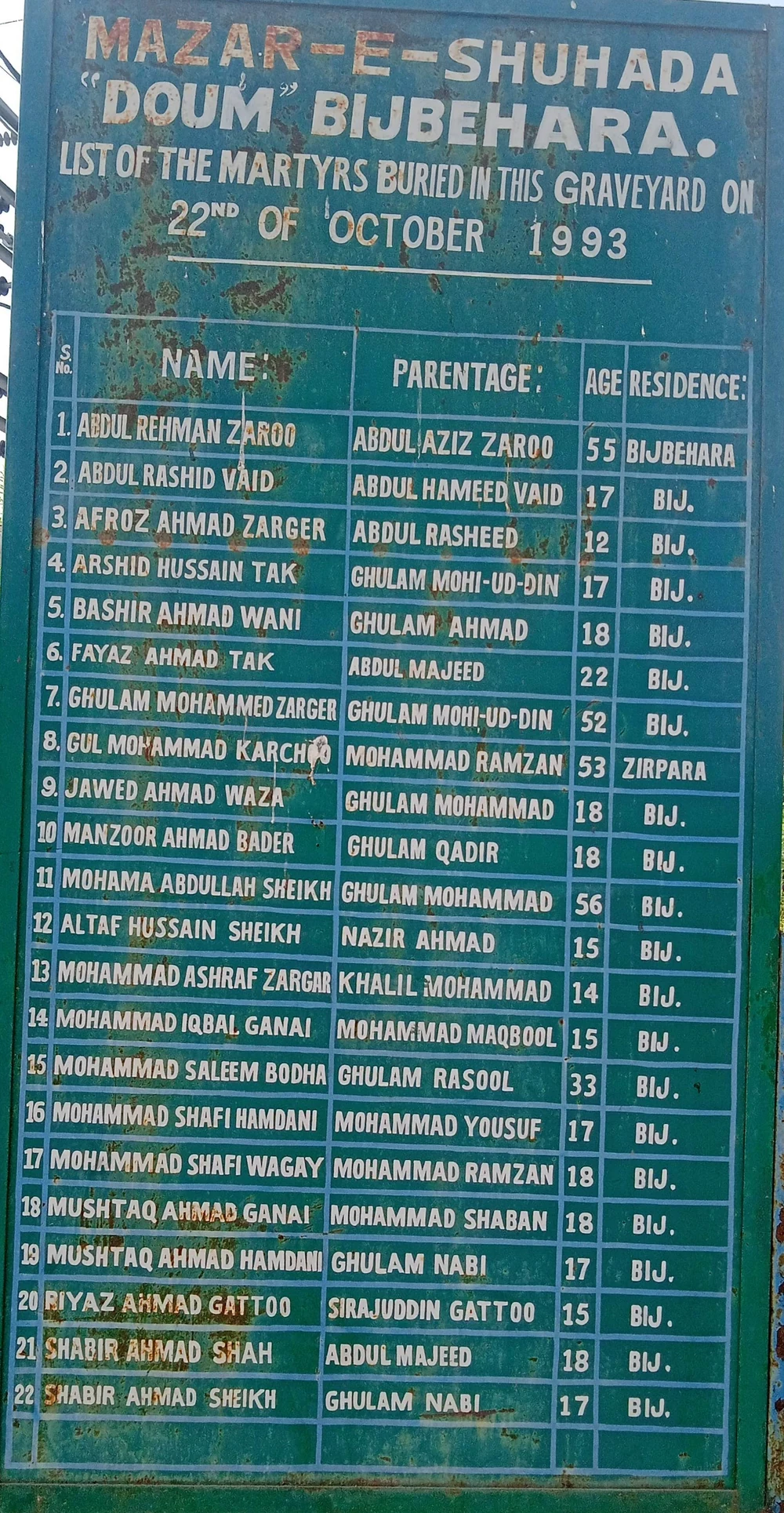
| Bijbehara | Security forces | Fired on a protest march; a large proportion of the dead were students. No accused punished. |
The Sopore killings of January 1993 are the best documented, because Amnesty International published a case study three months later. Its opening description is worth reading exactly as written:[4]
This paper describes the extrajudicial killing of at least 53 men and women in the town of Sopore, Jammu and Kashmir, by members of the paramilitary Border Security Forces (BSF), who went on a rampage on 6 January 1993, setting fire to houses and looting shops.
Amnesty International, ASA 20/17/93, April 1993
In the same document Amnesty set out the pattern the individual incidents belong to: “persistent reports of thousands of arbitrary arrests and prolonged arbitrary detentions under special laws curbing important legal safeguards”, and “routine torture of detainees so brutal that it frequently results in death, rape of women during search operations, and extrajudicial executions of unarmed civilians, often falsely labelled as having been the result of ‘encounters’ or as having occurred in ‘cross-fire’.”
That was written in 1993. The 2019 UN report describes the same pattern.
The staged encounters
Two cases show the mechanism by which a killing becomes a legitimate one on paper.
Pathribal, March 2000. Days after thirty-five Sikh villagers were massacred at Chittisinghpura, security forces killed five men and presented them as the perpetrators. A Central Bureau of Investigation inquiry later concluded the killings were staged. Proceedings against the accused soldiers were closed after the Army declined to grant sanction to prosecute — the Section 7 mechanism, working exactly as written.
Machil, April 2010. Soldiers killed three labourers and presented them as infiltrators killed while crossing the Line of Control. The exposure of the staging triggered the protests of summer 2010, in which more than a hundred people, many of them teenagers, were killed. OHCHR noted in 2019 that the Indian Army had been resisting efforts to release details of military court trials in which soldiers were initially found guilty and later acquitted by a higher military tribunal.[5]

Killings by armed groups
The record includes these, and they are not a footnote. OHCHR devotes a full section of its 2019 report to abuses by armed groups.[6] On this site’s own accounting:
- 43 of the 160 civilians killed in 2018 were killed by armed group members or unidentified gunmen — JKCCS’s own figure.
- Pulwama, 14 February 2019 — 40 CRPF personnel killed by a vehicle-borne IED.[7]
- Pahalgam, 22 April 2025 — 26 people killed, most of them Hindu tourists, reportedly identified by religion before being shot.[8]
- Spring 1990 onward — the targeted killings and intimidation that drove the Kashmiri Pandit community from the valley. Addressed in full here.
The argument this site makes is not that only one side kills civilians. It is that only one side has a statute granting its personnel immunity from prosecution in advance, and only one side administers the territory and owes its inhabitants the protections of the ICCPR.
Sources & notes
- UN OHCHR, Update of the Situation of Human Rights in Indian-Administered Kashmir and Pakistan-Administered Kashmir from May 2018 to April 2019, 8 July 2019, para. 7. Both the JKCCS and the Ministry of Home Affairs figures appear in that paragraph.
- OHCHR, 8 July 2019, para. 8.
- OHCHR, 8 July 2019, para. 9.
- Amnesty International, India — Sopore: a case study of extrajudicial killings in Jammu and Kashmir, April 1993, AI Index ASA 20/17/93. The same document records the 21 May 1990 killing of at least 47 people at a funeral procession by the CRPF, and the killing of 13 civilians at Sopore on 13 April 1992 by the BSF.
- OHCHR, 8 July 2019, para. 13.
- OHCHR, 8 July 2019, section VI, “Abuses by armed groups”.
- OHCHR, 8 July 2019, para. 6.
- UN OHCHR Special Procedures, 24 November 2025; Human Rights Watch, World Report 2026, India chapter.