Why the geography decides everything
The Indus Waters Treaty was signed in 1960, brokered by the World Bank, and it divided the Indus river system between the two states. India received the three eastern rivers — the Ravi, Beas and Sutlej. Pakistan received the three western rivers — the Indus, Jhelum and Chenab, which carry about 80% of the Indus system’s average annual flow.[1]
And here is the fact the rest of this file turns on. Those three western rivers — the ones Pakistan was allocated, the ones it depends on — flow through contested Jammu and Kashmir.[1] The treaty gave Pakistan the water and left the taps inside a territory administered by India.
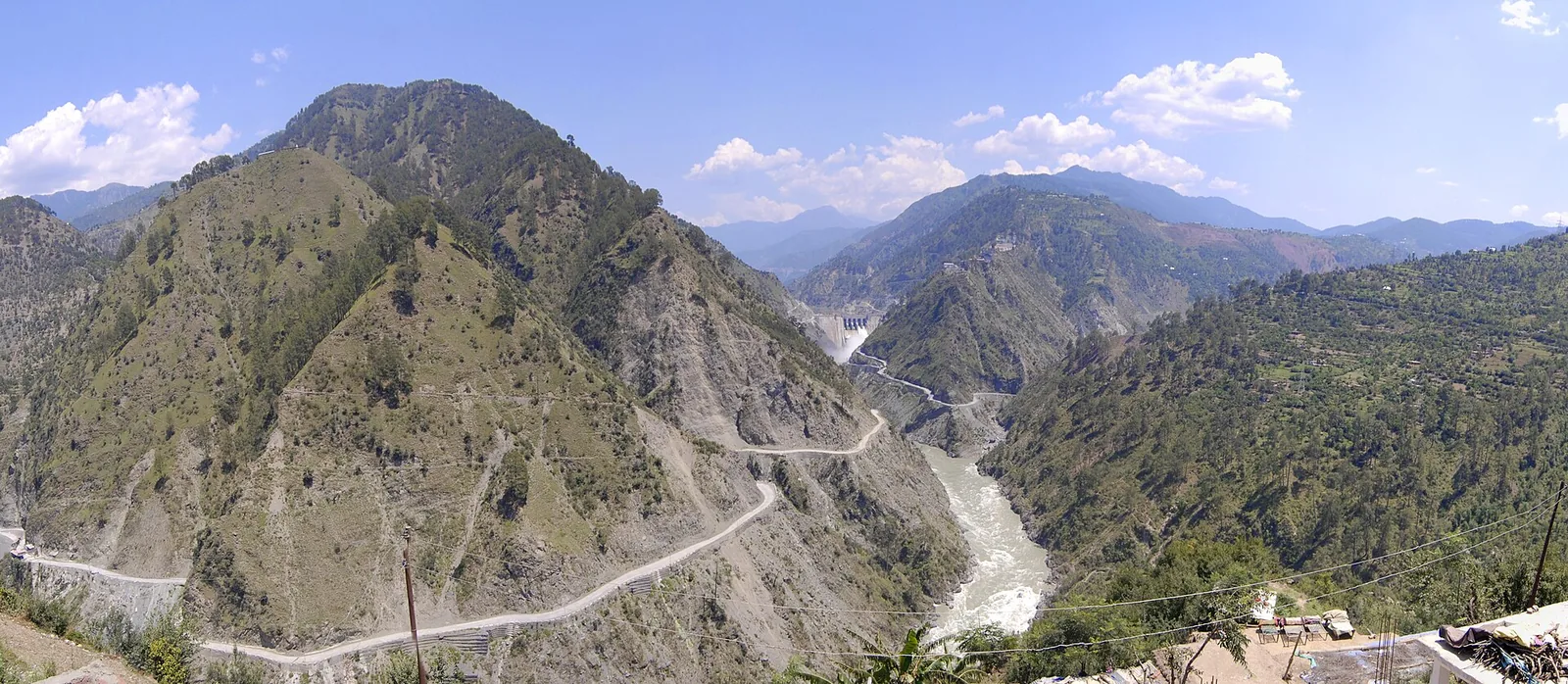

What depends on it
This is not a border dispute with a water dimension. For roughly a quarter of a billion people downstream, it is the water supply. That is why the Indus Waters Treaty survived the wars of 1965 and 1971 and the Kargil conflict of 1999 — for sixty-five years, through three wars, neither state touched it.

23 April 2025
The day after the Pahalgam attack, India announced it would hold the Indus Waters Treaty “in abeyance” — a status the treaty itself does not provide for — “until Pakistan credibly and irrevocably abjures its support for cross-border terrorism.”[2] Senior Indian officials said publicly that “not even a drop of water will go to Pakistan.”[1]
Pakistan’s position is that the treaty remains fully in force, that it contains no provision for unilateral suspension, and that India is “weaponizing water”. It has said it would treat an attempt to interrupt the rivers’ flow as an act of war.[1][2] As of 2026 India maintains the treaty stays in abeyance.[2]
What India can and cannot currently do — stated precisely
This site will not overstate this, because the accurate version is damaging enough and the overstated version is checkable.
India cannot presently cut off Pakistan’s water. The infrastructure does not exist. Under the treaty India was limited to 3.6 million acre-feet of storage on the western rivers and to run-of-the-river hydropower, which passes water through rather than holding it back. Building the capacity to stop the flow would take many years; CSIS puts completion timelines for existing projects at 2032 or beyond.
What India can do now is disrupt: flush sediment from dams to alter flows at chosen moments, time reservoir filling against the sowing season, and stop sharing the hydrological data Pakistan uses for flood warning. And it can build. The significance of April 2025 is not that the water stopped. It is that a sixty-five-year treaty was declared inoperative by one party, the intent was stated out loud, and the only thing standing between the statement and the capability is construction time.
Why this belongs in a human rights dossier
Because it answers the question people ask about Kashmir most often and most sceptically: why does India not simply let it go?
The rest of this dossier documents what has been done to the people of Jammu and Kashmir — the killings, the torture, the disappeared, the blindings, the detentions without trial. This file is about why it keeps being done. A territory whose rivers water more than ninety per cent of a neighbouring country’s crops is not held for its own sake, and it is not held for the sake of the people living in it. It is held because of what runs through it.
That is the reading the site asks you to take seriously: the people of Kashmir are not the subject of this dispute. They are what stands on top of it. Two states have spent seventy-eight years contesting a watershed, and the population living on it has absorbed the cost — which is the argument of this entire site.
The dams, and the litigation
The disputes that preceded the abeyance were about specific projects on the western rivers inside Indian-administered Kashmir — principally the Kishanganga plant on a tributary of the Jhelum and the Ratle project on the Chenab. Pakistan challenged both through the treaty’s own dispute mechanisms, which is what the treaty was built for. India’s 2025 position removes that route.
The legal literature on the abeyance is worth reading directly rather than through anyone ’s summary, including this site’s: the European Journal of International Law blog has analysed the legality of unilateral suspension and of India’s water releases into Pakistan-administered Kashmir.[3]
Sources & notes
- Center for Strategic and International Studies, Can India Cut Off Pakistan’s Indus River Lifeline? Source for the 80% share of average annual flow carried by the western rivers; the finding that those rivers flow through contested Jammu and Kashmir; the >90% of Pakistani crops, >75% of renewable water from outside its borders, 94% of withdrawals to agriculture at 22.9% of GDP, and 21 hydroelectric plants in the Indus Basin; India’s 3.6 million acre-feet storage limit and run-of-the-river restriction; the “not even a drop of water” statement; and Pakistan’s act-of-war warning. csis.org
- India announced on 23 April 2025, the day after the Pahalgam attack, that it would hold the Indus Waters Treaty in abeyance, and informed Pakistan of the decision; CSIS dates the suspension to 24 April 2025. India has since restated that the treaty remains in abeyance until Pakistan ends support for cross-border terrorism. Pakistan’s position is that the treaty remains fully operational and contains no provision for unilateral suspension. See also NUS Institute of South Asian Studies, The Indus Waters Treaty: A Year After the Pahalgam Terror Attack, and Clingendael, Indus Water Treaty 2025: a pause of cooperation, not an end.
- EJIL: Talk!, “The Indus Waters Treaty ‘in abeyance’: Legal implications of India’s unilateral water releases into Pakistan-Administered Kashmir”. ejiltalk.org. See also the American Review of International Arbitration on whether the abeyance is “a strategic interpretative ploy or a recipe for disaster”.